Tuesday, April 24, 2012

Introducing CYNESA!

CYNESA - the Catholic Youth Network for Sustainability in Africa- is growing steadily. The young men and women behind the initiative are more than convinced that their mission and agenda is crucial. In this post, i share with you an article that introduces CYNESA- and invite you to be part of this initiative.

CYNESA, the Catholic youth response to environmental challenges in Africa

April 16, 2012
Photo Credit: CYNESA
Allen Ottaro, Ngonidzashe Edward, SJ, and Tafara Ruvimbo Dandadzi
Despite the large numbers of Catholic youth that the Church in Africa is proud of, there exist only few initiatives addressing environmental concerns that are emerging from, and led by, the youth in Africa.  The duty to promote and safeguard the environment is “the responsibility of everyone”, as John Paul II pointed.  This realization was the subtle beginning of the Catholic Youth Network for Environmental Sustainability in Africa or CYNESA.  Inspired by John Paul II’s message for the World Day of Peace 1990, young Catholics from Kenya, Zimbabwe, Tanzania, and South Africa, drawn from and representing university chaplaincies and parish groups, joined up to respond to this invitation.
In November 2011, faith communities from around the world came together under the banner, We Have Faith – act now for climate justice, to champion for a just and robust outcome of the climate change talks in Durban, South Africa.  Young people from several African countries, joined by colleagues from Europe, formed a strong part of this initiative.  Indeed, many youth-led environmental movements are present in Africa, spurred on by the stark reality that Africa suffers enormously from the effects of climate change and environmental degradation.
Young people are now identifying the mission of CYNESA as the platform through which young Catholics across Africa can offer a response to the twin challenges of environmental degradation and climate change, from the perspective of Catholic social ethics, paying attention to the most vulnerable.  Taking advantage of social media that helped move the initiative, the network aims to respond through:
Education and awareness creation, by preparing a toolkit on climate change that draws from scripture and Catholic social ethics.
Networking and advocacy training, by seeking to establish and build relationships with like-minded partners, and to train young Christians in advocacy on environmental sustainability, and to link different initiatives on the continent.
Encouraging and supporting concrete action plans at the local level, by endeavoring to encourage young people to act in their parishes, schools, and within their youth movements by developing appropriate sustainable practices to conserve resources.
We welcome partnerships from other organizations already engaged in this mission in Africa and beyond, and hope that the network can be a tool that builds the Lord’s Kingdom, by caring for His creation.


Allen Ottaro, Ngonidzashe Edward, SJ, and Tafara Ruvimbo Dandadzi.


Mr Allen Ottaro is the Founding Executive Director of CYNESA and is based in Nairobi, Kenya.  Ngonidzashe Edward, SJ is a Jesuit Scholastic at Hekima College, also in Nairobi.  Mr Tafara Ruvimbo Dandadzi is the CYNESA Deputy Executive Director and Regional Coordinator for Southern Africa and is based in Zimbabwe.  For more information, please visit CYNESA.

Source:  http://ecojesuit.com/cynesa-the-catholic-youth-response-to-environmental-challenges-in-africa/2458/
Spanish: http://ecojesuit.com/cynesa-nuestra-respuesta-al-desafio-medioambiental-en-africa/2463/?lang=es
French: http://ecologyandchurches.wordpress.com/2012/04/18/avec-cynesa-des-jeunes-chretiens-africains-se-mobilisent/


The Role of Youth in Advocacy and Governance of Natural Resources in the context of a Green Economy-From Victims to Actors


My last post was about the news that followed after my trip to Bukavu, in the east of theDemocratic Republic of Congo. The main mission of my trip was to participate in an international conference on governance of collective natural resources. I presented a paper entitled, 'The Role of Youth in Advocacy and Governance of Natural Resources in the context of a Green Economy-From Victims to Actors'. In this blog post, i share with you the abstract and introduction of my paper.
Abstract

In June 1992, world leaders met in Rio de Janeiro at the United Nations Conference on Environment and Development. Also known as the ‘Earth Summit’ the conference resulted in the Agenda 21, as a comprehensive plan of actions to be taken globally, nationally and locally by organizations of the United Nations System, Governments, and Major Groups in every area in which human impacts on the environment.
Principle 21 of the document states that, ‘The creativity, ideals and courage of the youth of the world should
 be mobilized to forge a global partnership in order to achieve sustainable development and ensure a better
 future for all.’ while Principle 23 states that ‘The environment and natural resources of people under
 oppression, domination and occupation shall be protected.’ (1)
There is a clear connection between youth as actors in environmental governance that ensures natural
 resources in post conflict zones are protected. However, youth have often been victims of 
unsustainable natural resource exploitation in post conflict zones in the Great Lakes region. 
The next United Nations Conference on Sustainable Development or Rio+20[1], proposes the shift
 from brown economies to green economies, as well as a new institutional framework for sustainable
 development. This offers a renewed opportunity for youth to be key actors in advocacy and
 governance of the natural resources, as leaders in their communities, towards a green economy.
Presenting the paper to an attentive audience


Introduction
Documented advocacy for the good governance of natural resources can be traced back to the origins and beginnings of the environmental movement in the United States of America. One of the most well known personalities associated with this movement is writer, scientist and ecologist, Rachel Louise Carson, and who I was introduced to early in my Environmental Planning and Management study program. Growing up simply in the rural river town of Springdale, Pennsylvania, her mother bequeathed to her a life-long love of nature and the living world that Rachel expressed first as a writer and later as a student of marine biology. At a very youthful age of 25 and 29 years, Rachel earned an MA in Zoology and became the editor-in-chief of all publications for the U. S. Fish and Wildlife Service. Yet it is her book, ‘Silent Spring’, which she published while dying from cancer in 1962, and at the height of industrial and chemical pollution and destruction of nature, that won her international critical acclaim and galvanized the environmental movement, shaping the management of natural resources at various levels.
The United Nations Conference on Environment and Development (UNCED), held in the Swedish capital, Stockholm, in 1972, was one of the key milestones of this movement. Among the key outcomes of this conference was the setting up of the United Nations Environmental Program (UNEP), headquartered in Nairobi, Kenya.
In 1987, the famous Brundtland[2] Commission report on Sustainable Development was published. The report coined the concept ‘sustainable development’ and defined it as “ …development that meets the needs of the present without compromising the ability of future generations to meet their own needs.” (2) In 1992, the United Nations Conference on Environment and Development (UNCED), popularly known as the Earth Summit was held in the Brazilian city of Rio de Janeiro. The Earth Summit is widely remembered for having enshrined the Agenda 21 principles into the global sustainable development agenda. Principle 21 of the document recognized the importance of mobilizing youth globally, recognizing them as actors in a partnership that transcends geographical boundaries, in the pursuit of sustainable development, which includes the management of natural resources. Principle 23, explicitly expressed the need to protect natural resources of populations under oppression, domination and occupation. While post-conflict zones may or may not necessarily be described as being ‘under oppression, domination and occupation’, it is accurate to state that the conditions of living in post-conflict zones generally match those described in Principle 23 of Agenda 21. However, post-conflict zones may also exhibit characteristics of great potential in terms of socio-economic growth and a ‘re-birth’ of society, coupled with a greater sense of ownership and responsibility towards the management of natural resources, as a component that fuels and drives this ‘re-birth’. This paper seeks to examine the role of youth as key actors, especially in advocacy and governance of natural resource management in post-conflict zones, and especially in the context of a green-economy, which is one of the major themes for the United Nations Conference on Sustainable Development, Rio+20, to be held, again, in Rio de Janeiro, in 2012.
The first part will look at the concept of youth and what defines them. The second part will attempt to dissect the various interpretations of advocacy and governance, looking at how youth have been involved at various levels, and how it has been reflected in the management of natural resources. The third and final part will look at what is being proposed as the green economy and the opportunities it may offer for youth to be more effectively engaged in the management of natural resources in post-conflict zones.


[1] The United Nations Conference on Sustainable Development (UNCSD) is being organized in pursuance of General Assembly Resolution 64/236 (A/RES/64/236). The Conference will take place in Brazil on 20-22 June 2012 to mark the 20th anniversary of the 1992 United Nations Conference on Environment and Development (UNCED), in Rio de Janeiro, and the 10th anniversary of the 2002 World Summit on Sustainable Development (WSSD) in Johannesburg. It is envisaged as a Conference at the highest possible level, including Heads of State and Government or other representatives. The Conference will result in a focused political document. The Conference will focus on two themes: (a) a green economy in the context of sustainable development and poverty eradication; and (b) the institutional framework for sustainable development.
[2] Dr Gro Harlem Brundtland was born in Oslo, Norway, on 20 April 1939. A medical doctor and Master of Public Health (MPH), Gro Harlem Brundtland spent 10 years as a physician and scientist in the Norwegian public health system. For more than 20 years she was in public office, 10 of them as Prime Minister. In the 1980s she chaired the World Commission of Environment and Development (also known as the Brundtland Commission).

Monday, February 13, 2012

Bukavu...and the news that followed

I was trying to get some rest from a 31-hour bus trip,when news of a plane crash in the Eastern DRC town of Bukavu, started filtering through on the internet. That was Sunday, 12th February.
Just days earlier, Thursday morning, to be precise, i had left Bukavu by bus.
According to media reports, the plane was ferrying the finance minister and senior advisers to President Joseph Kabila, including the Governor of the South Kivu province. Apparently, the foreign pilots were flying into Kavuma airport on Bukavu for the first time. They overshot the runway and crashed, One senior presidential aide died while the finance minister, reportedly sustained serious injuries.

I was more curious about the condition of the Governor. On the evening of the 8th February, i was among conference participants that shared a dance floor with Governor Marcellin Cishambo, at a dinner party hosted at the end of a 3-day conference on natural resource management in post-conflict zones-the subject of my trip to Bukavu.
Governor Marcellin Cishambo (in bow tie) at the opening of the Conference in Bukavu

In fact, earlier that day, i had taken part in a group discussion in which the Governor participated, and even had a chance for a photo-op and a tete-a-tete afterwards. It was therefore a shock to learn that he had been in the ill-fated plane. Thankfully, the Governor's injuries are not life-threatening, even though he will be immobile for several months, if media reports are to be believed. I wish him and his colleagues a quick recovery.

In the meantime, stay tuned for posts on my experience in Bukavu and Rwanda.

Thursday, December 22, 2011

Déjà vu!

Déjà vu! Yes, i have experienced it a dozen times over. Eerie. And its happening...AGAIN!
Around this time last year, i was glued to the news, following by the minute, developments in Cote d'Ivoire as they unfolded. Some might remember the post titled 'The country with two presidents'.
This time, its happening even closer home.Africa's second largest country has had elections.Election 'observers' have described the process as fraught with flaws.The Supreme Court, ratified the results announced by the electoral commission, declaring the incumbent, Joseph Desire Kabila, as president-elect. The man has since taken the oath of office, while the country has witnessed heavy security deployments comprising boots and machines. (Zimbabwe's Robert Mugabe was the only foreign head of state who attended the ceremony.)
A campaign poster bearing Mr.Kabila's photo

Just like last year, the 'opposition man' Etienne Tshisekedi, has declared himself winner, and is organizing his swearing-in ceremony slated for tomorrow (Friday 23rd December), at Kinshasa's martyrs square. There is potential of many more 'martyrs' being created. We will effectively end up in a similar situation like Cote d'Ivoire's, a year ago. Déjà vu? I wish it were. Only this has happened before.
It is said (and don't ask me by who) that in Africa, incumbents never lose elections. I am happy that Zambia disproved this saying, where Michael Sata is now president and busy implementing his own brand of economics, dubbed 'Satanomics'. But i digress.

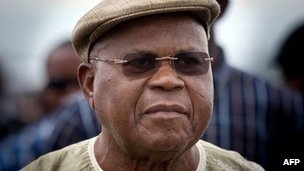
Mr. Tshisekedi who has declared himself president and 'issued an arrest warrant' for Mr.Kabila

Why am i so interested in the DRC situation? And why does it seem to me like there is little or no interest at all from 'the international community' (whoever they are!)?
I can only answer the first question. This Christmas, many kids across the world will receive playstations, laptops or iphones from 'Santa' (whoever he/she is). These electronic devices contain capacitors manufactured from tantalum, which is extracted from the mineral coltan. You may or may not remember that statement from this other post: 'Is there blood on your mobile phone?'
The DRC contains some of the world's largest coltan reserves, among a host of other mineral resources. However, the wars in the Congo have seen millions of people die and some of the most horrific and widespread cases of sexual violence against women. Remember the 'rape capital of the world' statement?
While kids in other parts of the world enjoy their 'gifts from Santa', their Congolese counterparts will be enduring the uncertainty that continues to engulf their land-especially when their country ends up with two presidents. And that's what worries and gets me really concerned.


Wednesday, December 21, 2011

East Africa in 2050

Recently i read a report about the integration process of the East African Community (EAC) that includes Kenya, Tanzania, Uganda, Rwanda and Burundi. According to the report, the EAC may have a single currency as early as 2015! Never mind that the Euro zone is deep in crisis raising questions about the viability of monetary unions.
So what will East Africa look like in 2050? Here are several scenarios that i stumbled upon a short while ago in 'The East African'. Makes for interesting reading!

SCENARIO 1: THE WATER POWERS
The first force driving border changes could be water and fuel. Virtually all the countries in the region, except Tanzania, face serious water stress in the next few years. Kenya is the most stressed: each Kenyan only has 636 cubic metres of water a year, compared with 1,270 cubic metres in Uganda and 2,035 in Tanzania. As a rule of thumb, hydrologists consider 2,000 cubic metres per person per year as the point when a country is considered “water-stressed”, and 1,000 cubic metres as when the situation is critical, and a country is “water-scarce”. So Kenya is “finished”. Water scarcity is likely to hit Uganda by 2035, and water stress will hit the country even earlier, by the year 2020.  At the present rate of deforestation, it is predicted that Uganda is likely to be importing fuel wood by 2020. Nairobi water demand stands at 750,000 cubic metres a day against a supply capacity of 530,000 cubic metres. It is projected that the daily demand in 2020 will stand at 1.6 million cubic metres and climb to 2.2 million cubic metres by 2030. So Nairobi City could collapse. In this scenario, the most successful countries will be the water-rich ones or those that have been smart at environmental management: In this scenario, Rwanda and a resurgent DR Congo could eat up Uganda; and Tanzania will become the regional superpower, swallowing most of Kenya. South Sudan will take a chunk of Kenyan and Ethiopian territory.
SCENARIO 2: THE DEMOCRACY POWERS
The future of most East African nations is uncertain, because the political elite have not arrived at a long-term deal on power sharing and enshrined it in a constitution. As a result, the regimes in Burundi, Rwanda, Tanzania, South Sudan and Ethiopia all today still need to call out the army or special forces to beat back the opposition. The only country, paradoxically, that has solved this problem is Kenya. It is the only nation in the sub region where, in the past two years, the power class has worked itself into a position where it can hold power through trickery, patronage, and sweet-talking without bringing out the army.
In July this year, Kenya’s government became the first in Africa — and one of the first in the world — to be completely data open. It has a level of openness on government data that is higher than the US’s. If it can leverage all these into political dividends and the other nations don’t sort themselves out quickly, it is easy to see Kenya becoming a Democracy Top Dog and swallowing half of South Sudan, most of Uganda, and a chunk of Tanzania to become a mind-bogglingly expanded nation.
SCENARIO 3: THE RESOURCE POWERS (ENERGY & MINERALS)
When it comes to resources, Kenya does badly, as do Rwanda and Burundi, and Somalia. Rwanda’s main resource is natural gas, with 56 billion cubic metres of natural gas reserves. The resource king in the region is DRC. According to a recent report by Africa Business, the country has $24 trillion worth of untapped mineral deposits, which is equivalent to the GDP of Europe and the United States combined. The DRC has the world’s largest reserves of cobalt and significant quantities of the world’s diamonds, gold and copper. This makes the DRC potentially the richest country in the world. Then there is Tanzania. It has gold reserves of 45 million ounces, and is currently the third-largest gold producer in Africa. A recent geological survey revealed 209 million tonnes of nickel reserves, 50.9 million carats of diamond, and 103 million tonnes of iron ore, as well as 6.5 billion cubic metres of natural gas. Uganda is oil rich, with 1.5 billion barrels of oil reserves. South Sudan too has 3.5 billion - 5 billion barrels of oil reserves.
In this scenario, Tanzania will ingest Burundi, Uganda and DRC would eat Rwanda for lunch, and Kenya would all but disappear, being carved up between Uganda, Tanzania, and South Sudan. Ethiopia would, largely, remain intact.
SCENARIO 4: THE TECHNOLOGY POWERS
Despite lack of natural resources, a country can rise to power through innovation and becoming a leader in science and industry (as Japan teaches us). In East Africa today, the two nations investing heavily in technology innovation are Kenya and Rwanda. Kenya is now dubbed “the Silicon Savannah”.
Rwanda is also investing in IT education, and public health care like no other East African nation. Kenya’s private sector medical industry is years ahead of its peers. Kenya’s innovative capacity is ranked an impressive 52nd globally [third in Africa after Tunisia at 49th and South Africa at 51st], with high company spending on R&D and good scientific research institutions that collaborate well with the business sector in research activities (Global Competitiveness Report 2011/12, Word Economic Forum). The Global Competitiveness Report also showed Kenya with the second highest number of utility patents (i.e. patents for innovation) granted in sub-Saharan Africa, and fifth in Africa if you include Tunisia, Egypt and Algeria, at 0.02 patents per million of the population, which translates into 800,000 patents.
Kenyan operator Safaricom became the first-ever telecom company to create a mass mobile-banking service, setting industry standards now being copied from California to Kabul. By May of this year, Ushahidi, a crowd-sourcing platform developed in Nairobi in early 2008, which is free to download, had been used 14,000 times in 128 countries to map everything from last year’s earthquake in Haiti to this year’s Japanese tsunami and the Arab Spring.
If technology, innovation and the development of the health industry are the future, then Kenya and Rwanda will chew up Uganda, and Rwanda will gobble up Burundi and a large swathe of eastern DRC. A large part of Tanzania, and South Sudan would become Kenya territory. Interestingly, this is probably the only scenario where Somalia survives. It’s a fairly innovative country in communications, so it will survive. It will be reunited with Somaliland and Puntland, and take in the Somali/Ogaden of Ethiopia.
SCENARIO 5: THE ENERGY-AND-FOOD-HUNGRY MILITARY POWERS
The next group of winners could be countries that reasonably stabilise their internal politics, grow their economies and build strong militaries, but have no food and energy to run on. These countries will take account of the rich ones that have resources, but are disorganised, have weak militaries, and chaotic politics.
In this scenario, Rwanda will thrive. Uganda might just get by, but not enough to grow out much. Burundi might survive. Kenya, whose real military strength, it emerges, has been grossly underestimated from what we are learning from its Somalia campaign and with an interesting new political order, will thrive as well as Rwanda. Ethiopia too will do quite well. There are questions about Tanzania in this picture, as there are about South Sudan, and Somalia is a write off. So, Rwanda will expand and absorb DR Congo and its resources. Burundi too will expand considerably into the DR Congo and parts of Tanzania. There will be a small portion of DRC left that Uganda will pick up. Uganda will also pick up a little of South Sudan, but most of it will go Ethiopia and Kenya. Kenya and Ethiopia will divvy up Somalia. Kenya might get a little bite of Tanzania. Whatever the case, Tanzania will shrink.
Source:  http://www.theeastafrican.co.ke/news/-/2558/1291160/-/ngqlltz/-/index.html

Wednesday, September 14, 2011

To Wrocław and Mollina

Today marks the last full working day of my 7 month internship with the Torun Ecological Association "Tilia".However, the next few days before my flight back to Nairobi will still be quite busy!
I will take the train tomorrow to Wroclaw, and on Friday i will participate in the 19th Annual Plenary Session & Conference of European Environment and Sustainable Development Advisory Councils network. The meeting has actually already started with internal meetings of the EEAC network, which is an independent body that advises the European governments on matters of environment and sustainability, as the title suggests. The conference is also serving as a preparatory forum for the next Earth Summit in Brazil in 2012, popularly known as Rio+20.I am really looking forward to learning a great deal and possibly making some important contacts for the future.
Later on Saturday morning, September 17th, i will take the train to Warsaw where i will stay overnight, before flying to Malaga, Spain on Sunday morning.
Every year, the North-South Centre of the Council of Europe in collaboration with other partners, organizes the University on Youth and Development (UYD).It serves as a forum where young people meet to train and be trained, to share and discuss, and to come up with plans of action, on important development issues of the day.


This year's theme focusses on the role of youth volunteering for global development.Started in the year 2000, the UYD is hosted at the Centre for European and Latin American Youth (CEULAJ) located in the village of Mollina, 50 kilometres from Malaga.
It seems to me that the common thread running through all these meetings, is a fundamental human desire to make the world a better place to live in. I definitely want in on any initiative that seeks to do that, and hope that i can learn skills, gain knowledge and build friendships, that i can then pass on to other people wherever next i find myself in.Lastly, i found this video and thought it fits in today's blog post.


Maybe you too are already involved or would like to get involved in making the world more just? Perhaps you have ideas or experiences to share? If so, please feel free to get in touch.I'd love to hear from you!

Monday, September 12, 2011

September 12th...

First came the prediction and warning: June 22nd 2008


Then came the tragedy:


...And a shocking display of ignorance from some 'politicians':


...and it all makes me extremely ANGRY!!