Thursday, December 22, 2011

Déjà vu!

Déjà vu! Yes, i have experienced it a dozen times over. Eerie. And its happening...AGAIN!
Around this time last year, i was glued to the news, following by the minute, developments in Cote d'Ivoire as they unfolded. Some might remember the post titled 'The country with two presidents'.
This time, its happening even closer home.Africa's second largest country has had elections.Election 'observers' have described the process as fraught with flaws.The Supreme Court, ratified the results announced by the electoral commission, declaring the incumbent, Joseph Desire Kabila, as president-elect. The man has since taken the oath of office, while the country has witnessed heavy security deployments comprising boots and machines. (Zimbabwe's Robert Mugabe was the only foreign head of state who attended the ceremony.)
A campaign poster bearing Mr.Kabila's photo

Just like last year, the 'opposition man' Etienne Tshisekedi, has declared himself winner, and is organizing his swearing-in ceremony slated for tomorrow (Friday 23rd December), at Kinshasa's martyrs square. There is potential of many more 'martyrs' being created. We will effectively end up in a similar situation like Cote d'Ivoire's, a year ago. Déjà vu? I wish it were. Only this has happened before.
It is said (and don't ask me by who) that in Africa, incumbents never lose elections. I am happy that Zambia disproved this saying, where Michael Sata is now president and busy implementing his own brand of economics, dubbed 'Satanomics'. But i digress.

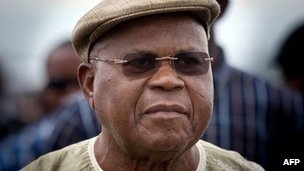
Mr. Tshisekedi who has declared himself president and 'issued an arrest warrant' for Mr.Kabila

Why am i so interested in the DRC situation? And why does it seem to me like there is little or no interest at all from 'the international community' (whoever they are!)?
I can only answer the first question. This Christmas, many kids across the world will receive playstations, laptops or iphones from 'Santa' (whoever he/she is). These electronic devices contain capacitors manufactured from tantalum, which is extracted from the mineral coltan. You may or may not remember that statement from this other post: 'Is there blood on your mobile phone?'
The DRC contains some of the world's largest coltan reserves, among a host of other mineral resources. However, the wars in the Congo have seen millions of people die and some of the most horrific and widespread cases of sexual violence against women. Remember the 'rape capital of the world' statement?
While kids in other parts of the world enjoy their 'gifts from Santa', their Congolese counterparts will be enduring the uncertainty that continues to engulf their land-especially when their country ends up with two presidents. And that's what worries and gets me really concerned.


Wednesday, December 21, 2011

East Africa in 2050

Recently i read a report about the integration process of the East African Community (EAC) that includes Kenya, Tanzania, Uganda, Rwanda and Burundi. According to the report, the EAC may have a single currency as early as 2015! Never mind that the Euro zone is deep in crisis raising questions about the viability of monetary unions.
So what will East Africa look like in 2050? Here are several scenarios that i stumbled upon a short while ago in 'The East African'. Makes for interesting reading!

SCENARIO 1: THE WATER POWERS
The first force driving border changes could be water and fuel. Virtually all the countries in the region, except Tanzania, face serious water stress in the next few years. Kenya is the most stressed: each Kenyan only has 636 cubic metres of water a year, compared with 1,270 cubic metres in Uganda and 2,035 in Tanzania. As a rule of thumb, hydrologists consider 2,000 cubic metres per person per year as the point when a country is considered “water-stressed”, and 1,000 cubic metres as when the situation is critical, and a country is “water-scarce”. So Kenya is “finished”. Water scarcity is likely to hit Uganda by 2035, and water stress will hit the country even earlier, by the year 2020.  At the present rate of deforestation, it is predicted that Uganda is likely to be importing fuel wood by 2020. Nairobi water demand stands at 750,000 cubic metres a day against a supply capacity of 530,000 cubic metres. It is projected that the daily demand in 2020 will stand at 1.6 million cubic metres and climb to 2.2 million cubic metres by 2030. So Nairobi City could collapse. In this scenario, the most successful countries will be the water-rich ones or those that have been smart at environmental management: In this scenario, Rwanda and a resurgent DR Congo could eat up Uganda; and Tanzania will become the regional superpower, swallowing most of Kenya. South Sudan will take a chunk of Kenyan and Ethiopian territory.
SCENARIO 2: THE DEMOCRACY POWERS
The future of most East African nations is uncertain, because the political elite have not arrived at a long-term deal on power sharing and enshrined it in a constitution. As a result, the regimes in Burundi, Rwanda, Tanzania, South Sudan and Ethiopia all today still need to call out the army or special forces to beat back the opposition. The only country, paradoxically, that has solved this problem is Kenya. It is the only nation in the sub region where, in the past two years, the power class has worked itself into a position where it can hold power through trickery, patronage, and sweet-talking without bringing out the army.
In July this year, Kenya’s government became the first in Africa — and one of the first in the world — to be completely data open. It has a level of openness on government data that is higher than the US’s. If it can leverage all these into political dividends and the other nations don’t sort themselves out quickly, it is easy to see Kenya becoming a Democracy Top Dog and swallowing half of South Sudan, most of Uganda, and a chunk of Tanzania to become a mind-bogglingly expanded nation.
SCENARIO 3: THE RESOURCE POWERS (ENERGY & MINERALS)
When it comes to resources, Kenya does badly, as do Rwanda and Burundi, and Somalia. Rwanda’s main resource is natural gas, with 56 billion cubic metres of natural gas reserves. The resource king in the region is DRC. According to a recent report by Africa Business, the country has $24 trillion worth of untapped mineral deposits, which is equivalent to the GDP of Europe and the United States combined. The DRC has the world’s largest reserves of cobalt and significant quantities of the world’s diamonds, gold and copper. This makes the DRC potentially the richest country in the world. Then there is Tanzania. It has gold reserves of 45 million ounces, and is currently the third-largest gold producer in Africa. A recent geological survey revealed 209 million tonnes of nickel reserves, 50.9 million carats of diamond, and 103 million tonnes of iron ore, as well as 6.5 billion cubic metres of natural gas. Uganda is oil rich, with 1.5 billion barrels of oil reserves. South Sudan too has 3.5 billion - 5 billion barrels of oil reserves.
In this scenario, Tanzania will ingest Burundi, Uganda and DRC would eat Rwanda for lunch, and Kenya would all but disappear, being carved up between Uganda, Tanzania, and South Sudan. Ethiopia would, largely, remain intact.
SCENARIO 4: THE TECHNOLOGY POWERS
Despite lack of natural resources, a country can rise to power through innovation and becoming a leader in science and industry (as Japan teaches us). In East Africa today, the two nations investing heavily in technology innovation are Kenya and Rwanda. Kenya is now dubbed “the Silicon Savannah”.
Rwanda is also investing in IT education, and public health care like no other East African nation. Kenya’s private sector medical industry is years ahead of its peers. Kenya’s innovative capacity is ranked an impressive 52nd globally [third in Africa after Tunisia at 49th and South Africa at 51st], with high company spending on R&D and good scientific research institutions that collaborate well with the business sector in research activities (Global Competitiveness Report 2011/12, Word Economic Forum). The Global Competitiveness Report also showed Kenya with the second highest number of utility patents (i.e. patents for innovation) granted in sub-Saharan Africa, and fifth in Africa if you include Tunisia, Egypt and Algeria, at 0.02 patents per million of the population, which translates into 800,000 patents.
Kenyan operator Safaricom became the first-ever telecom company to create a mass mobile-banking service, setting industry standards now being copied from California to Kabul. By May of this year, Ushahidi, a crowd-sourcing platform developed in Nairobi in early 2008, which is free to download, had been used 14,000 times in 128 countries to map everything from last year’s earthquake in Haiti to this year’s Japanese tsunami and the Arab Spring.
If technology, innovation and the development of the health industry are the future, then Kenya and Rwanda will chew up Uganda, and Rwanda will gobble up Burundi and a large swathe of eastern DRC. A large part of Tanzania, and South Sudan would become Kenya territory. Interestingly, this is probably the only scenario where Somalia survives. It’s a fairly innovative country in communications, so it will survive. It will be reunited with Somaliland and Puntland, and take in the Somali/Ogaden of Ethiopia.
SCENARIO 5: THE ENERGY-AND-FOOD-HUNGRY MILITARY POWERS
The next group of winners could be countries that reasonably stabilise their internal politics, grow their economies and build strong militaries, but have no food and energy to run on. These countries will take account of the rich ones that have resources, but are disorganised, have weak militaries, and chaotic politics.
In this scenario, Rwanda will thrive. Uganda might just get by, but not enough to grow out much. Burundi might survive. Kenya, whose real military strength, it emerges, has been grossly underestimated from what we are learning from its Somalia campaign and with an interesting new political order, will thrive as well as Rwanda. Ethiopia too will do quite well. There are questions about Tanzania in this picture, as there are about South Sudan, and Somalia is a write off. So, Rwanda will expand and absorb DR Congo and its resources. Burundi too will expand considerably into the DR Congo and parts of Tanzania. There will be a small portion of DRC left that Uganda will pick up. Uganda will also pick up a little of South Sudan, but most of it will go Ethiopia and Kenya. Kenya and Ethiopia will divvy up Somalia. Kenya might get a little bite of Tanzania. Whatever the case, Tanzania will shrink.
Source:  http://www.theeastafrican.co.ke/news/-/2558/1291160/-/ngqlltz/-/index.html

Wednesday, September 14, 2011

To Wrocław and Mollina

Today marks the last full working day of my 7 month internship with the Torun Ecological Association "Tilia".However, the next few days before my flight back to Nairobi will still be quite busy!
I will take the train tomorrow to Wroclaw, and on Friday i will participate in the 19th Annual Plenary Session & Conference of European Environment and Sustainable Development Advisory Councils network. The meeting has actually already started with internal meetings of the EEAC network, which is an independent body that advises the European governments on matters of environment and sustainability, as the title suggests. The conference is also serving as a preparatory forum for the next Earth Summit in Brazil in 2012, popularly known as Rio+20.I am really looking forward to learning a great deal and possibly making some important contacts for the future.
Later on Saturday morning, September 17th, i will take the train to Warsaw where i will stay overnight, before flying to Malaga, Spain on Sunday morning.
Every year, the North-South Centre of the Council of Europe in collaboration with other partners, organizes the University on Youth and Development (UYD).It serves as a forum where young people meet to train and be trained, to share and discuss, and to come up with plans of action, on important development issues of the day.


This year's theme focusses on the role of youth volunteering for global development.Started in the year 2000, the UYD is hosted at the Centre for European and Latin American Youth (CEULAJ) located in the village of Mollina, 50 kilometres from Malaga.
It seems to me that the common thread running through all these meetings, is a fundamental human desire to make the world a better place to live in. I definitely want in on any initiative that seeks to do that, and hope that i can learn skills, gain knowledge and build friendships, that i can then pass on to other people wherever next i find myself in.Lastly, i found this video and thought it fits in today's blog post.


Maybe you too are already involved or would like to get involved in making the world more just? Perhaps you have ideas or experiences to share? If so, please feel free to get in touch.I'd love to hear from you!

Monday, September 12, 2011

September 12th...

First came the prediction and warning: June 22nd 2008


Then came the tragedy:


...And a shocking display of ignorance from some 'politicians':


...and it all makes me extremely ANGRY!!

Kenyans, Freebies and Impunity

Its a sad day for East Africa.Even before the news of a ferry tragedy in Zanzibar, that killed hundreds of people, over one hundred more lives have been lost in a fire tragedy in Nairobi.Deep condolences go out to all affected, and wishes for a quick recovery to all those hospitalized.
Rescue efforts were particularly challenging in both cases. Both tragedies could have been averted.
In February of 2009, John Ngirachu, a journalist at the Nation newspaper in Nairobi, and a former university colleague, wrote about a looming fire disaster in the Mukuru Sinai slums. He and a fellow journalist reported how residents had resisted attempts to move them from the oil pipeline area in which they were living.


They quoted a local pastor as saying “The Bible says that God is fire,” the 45-year-old pastor says. “Well, my church is right on top of the pipeline, and I am always aware of the possibility of a fire outbreak.”
It is now September 2011, and a fierce fire did break out...adding to a long list of tragedies that could have been averted. It is a culture of impunity. A culture that has fatal results.

Saturday, September 10, 2011

Another day...and a week coming up!

My office-issued laptop no longer detects the wireless network available in the building that has been my home for the past close-to-seven-months now. Wi-fi doesn't seem to be available anyway, because even my phone no longer picks up the signals.
It is Saturday evening, which means i cannot access the internet from the office, which is closed (it was open  since my colleagues and i worked today too).The implication is that i have to sit at the reception, where a computer connected to the internet is available. Again, being a Saturday, like many other Saturdays, also means that a wedding party is going on. In fact, when i got started on this post, the newly wedded couple made its grand entrance into the building, which has an excellent conference hall, for their wedding party, and were greeted with rousing applause by family and friends.I no longer own a camera, so no photos to share....sorry!
My room is a few meters from the conference hall. Therefore, when the music starts playing, i will be unable to do much else...other than try to watch a movie...or spend sometime online.But again, the latter activity is only possible at the reception and i am not sure that i want to be here longer.We'll see. Its not the first time anyway!One thing is sure though. I will be waking up really late tomorrow.I am not complaining here;just telling my story!
Tomorrow also marks the start of another week. I sense already that it will be a week full of emotions, ideas and opportunities.On Tuesday evening, my colleagues will say 'goodbye' officially at some ceremony. It (the ceremony) should be simple, i hope, but i know saying goodbye will not. These are men and women that i have shared an office with every single working day, for the past 7 months!We have shared joys, challenges, hopes...and lots of coffee, tea and cake too. It is not easy to say 'kwaheri' to people like these.
Thursday morning will see me catch a train to Wroclaw. I have heard a lot about this city, but was never able to go there. Next week, the European Environmental Advisory Council (EEAC) will host its 19th annual conference at the Wroclaw University of Technology. The Polish minister of Environment will be one of the key note speakers. It will really be an honour for me to be present at the conference. It will be a whole day conference, Friday, and there won't be time left for anything else after. Maybe i'll try to explore Wroclaw by night.
Early Saturday, and i'll be on another train-this time to Warsaw, so i can catch a flight to Malaga, Spain, early Sunday morning.I'll be attending the University on Youth and Development (UYD), in the Spanish town of Mollina, close to Malaga.That will be another week altogether!
For now, its probably time to log-off and retire to my room...a few meters from the conference hall...where a wedding party is in progress...

Thursday, September 8, 2011

Surprising Europe?!

With less than three weeks left before i board a flight back to Nairobi, marking the end of my 7-month long experience in Poland, many of my friends have been asking me how the time here has been for me.It is impossible to capture in words, the very rich and diverse moments and relationships that have characterized my stay here.But the conclusion always is'yes, i definitely want to come back...for an even longer period!'
But life has its low moments too, no matter which part of the world you live in.Mine was no exception. And while reviewing and reflecting on the past weeks and months, i stumbled upon a documentary series called 'Surprising Europe'.
The series is running on the Al Jazeera network, and documents the lives of African immigrants in Europe-a window into the experiences that they live with all its joys and pains.It makes for interesting viewing, and i think everyone, immigrant or not, should watch it. Below is a trailer for the series and you can read comments on the series on the 'Surprising Europe' website.


The only thing i am really surpsised about is how fast my time here has gone!!